Novacène (group show)
Gare Saint Sauveur, Lille, France
May 14 – October 2, 2022
Part of Utopia season, lille3000
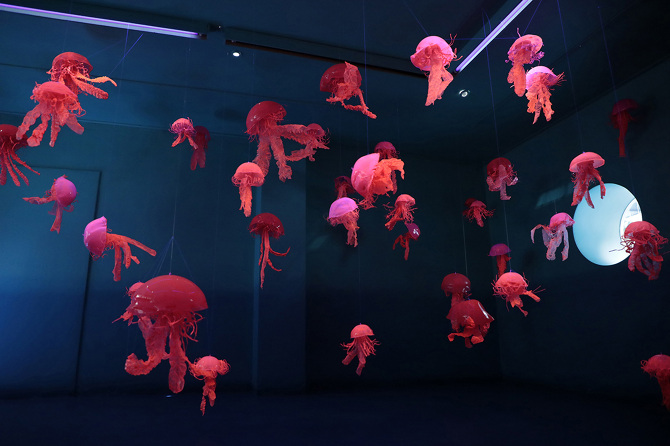
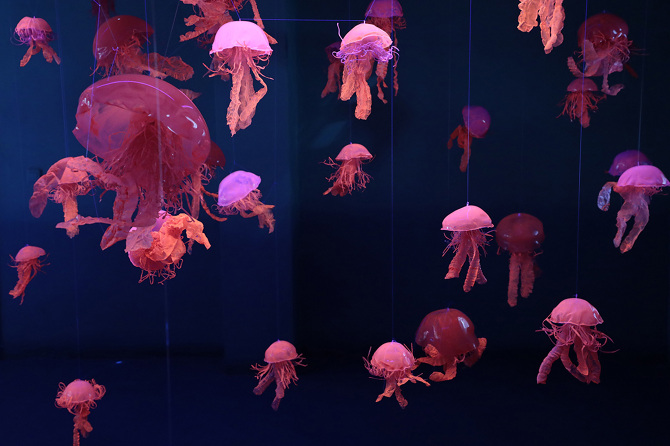
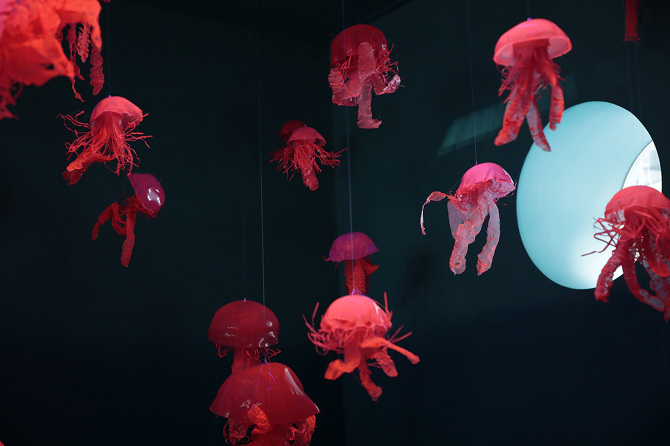
Slow Dance
2022
Recycled plastic, acrylic hemisphere, acrylic color, gel medium, wire
Dimensions variable
Installation view of ‘Novacène’ at Gare Saint Sauveur, Lille, France, 2022
Photo: Jerome Mizar
Novacene
By Alice Audouin and Jean-Max Colard
INTRODUCTION
In his latest book, Novacene, the renowned English environmentalist, scientist and centenarian James Lovelock imagines the advent of a new era, the Novacene, which will follow our current geological era, the Anthropocene, marked by climatic and environmental upheavals attributable to human activity. Fifty years after his “Gaia hypothesis”, which posits that the Earth is a living being, Lovelock shares his optimism in this testamentary work and prophecies the advent of a positive relationship between humans and the environment, aided by technology.
This hopeful vision is the guiding thread of our exhibition. Novacene’s presence at the heart of this future utopia adds a touch of dark humour by considering the world we live in today, a world beset by ecological disasters, as a bygone era.
Drawing on the imagination, commitment and foresight of contemporary artists, the exhibition explores the road we still have to travel to reach this future civilisational era.This impulse towards a less carbon-intensive world where there is greater equality between humans and “other-than-humans” is based on a profound change in our societies, in our vision of the world and in our relationship with living beings. It implies technological innovations as well as a vital return to the Earth, but also new ethical dilemmas.
This challenge seems quite utopian at a time when global warming forecasts (up to +3.5° by 2100 if we do not act) are more pessimistic than ever. But isn’t the function of art precisely to reflect on possible change, and even to accelerate it?
Through their works, artists enable us to resynchronise our relationship to time, by connecting human time to Earth time, to rethink our part as a species among species and to propose a more shared approach to the world.
Novacene offers a place of exploration, dream and union for a viable future of our planet.
Traces of a fossil world
On the verges of the Gare Saint Sauveur, on the fringes of the Novacene exhibition, in the buried depths of this former industrial and railway hall, the traces and ruins of our fossil world are presented like the remains of a bygone world discovered from the distant future, just like the ancient civilisations that we visit today in archaeological sites.
What future view will we have of our present time, when the use of fossil fuels, especially oil, has contributed to an unprecedented technical and economic boom, but also to global warming and its consequences?
Petrified petrol pump stations of the duo Allora & Calzadilla or John Gerrard’s “Western Flag” are symbols of a world that still exists but whose death knell is being sounded by the depletion of fossil fuel deposits and their replacement by renewable
energy. Similarly, fossils of telephones and computers and the remains of the Last Man imagined by the Belgian artist Maarten Vanden Eynde, as well as the sculptures created and displayed by Julian Charrière from petrified minerals, underline the role of technology in the depletion of resources and attest to the history that was (and still is) ours: that of grandiose discoveries in the fields of energy and technology, which, through an indirect effect such as global warming, have jeopardised the conditions of life on Earth. Evoking both nuclear catastrophe and the rebirth of the post-apocalyptic landscape, Taisia Korotkova’s large panoramic canvases usher us into the presence of a world that is emerging after the collapse of industrial civilisation and open the way to the Novacene.
Utopia Hotel
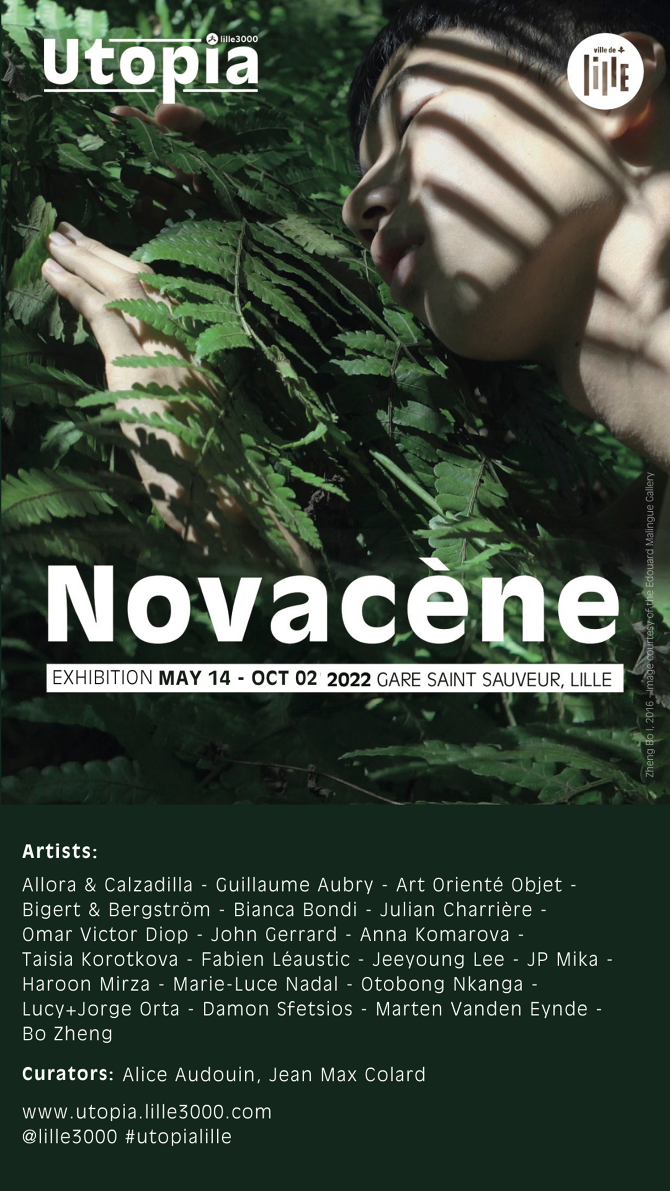
For the Novacene exhibition, Hôtel Utopia offers a series of immersive spaces where visitors are invited to explore new relationships with the living world. At the same time an environmental manifesto and a futuristic laboratory, Hôtel Utopia plunges into the era of the “Novacene”, as prophesied in 2019 in scientist and environmentalist James Lovelock’s description of the future of life on Earth. Hôtel Utopia becomes a place of poetic and visionary encounters with possible living forms and species. In a faraway future, where geological eras follow in succession, unexpected scenarios appear before us: JeeYoung Lee’s kingdom of jellyfish or the “Standing Dog” by the duo Art Orienté Objet. In this future world, humans will have descended from the top of the “phylogenetic tree” (which represents the evolution of species) to take a more equal place among other species, with artist Fabien Léaustic. In these times of finally reconciled ecosystems, the atmosphere captured by Marie-Luce Nadal will enable the creation of intimate skies and the relationships between species will also have their share of sensuality, as proven by these acts of phyto-love by the Chinese artist Zheng Bo.
The ecological future will be sexy, inventive and technophile, nothing else will do.
Gare Saint Sauveur, Lille, France
May 14 – October 2, 2022
Part of Utopia season, lille3000
Slow Dance
2022
Recycled plastic, acrylic hemisphere, acrylic color, gel medium, wire
Dimensions variable
Installation view of ‘Novacène’ at Gare Saint Sauveur, Lille, France, 2022
Photo: Jerome Mizar
Novacene
By Alice Audouin and Jean-Max Colard
INTRODUCTION
In his latest book, Novacene, the renowned English environmentalist, scientist and centenarian James Lovelock imagines the advent of a new era, the Novacene, which will follow our current geological era, the Anthropocene, marked by climatic and environmental upheavals attributable to human activity. Fifty years after his “Gaia hypothesis”, which posits that the Earth is a living being, Lovelock shares his optimism in this testamentary work and prophecies the advent of a positive relationship between humans and the environment, aided by technology.
This hopeful vision is the guiding thread of our exhibition. Novacene’s presence at the heart of this future utopia adds a touch of dark humour by considering the world we live in today, a world beset by ecological disasters, as a bygone era.
Drawing on the imagination, commitment and foresight of contemporary artists, the exhibition explores the road we still have to travel to reach this future civilisational era.This impulse towards a less carbon-intensive world where there is greater equality between humans and “other-than-humans” is based on a profound change in our societies, in our vision of the world and in our relationship with living beings. It implies technological innovations as well as a vital return to the Earth, but also new ethical dilemmas.
This challenge seems quite utopian at a time when global warming forecasts (up to +3.5° by 2100 if we do not act) are more pessimistic than ever. But isn’t the function of art precisely to reflect on possible change, and even to accelerate it?
Through their works, artists enable us to resynchronise our relationship to time, by connecting human time to Earth time, to rethink our part as a species among species and to propose a more shared approach to the world.
Novacene offers a place of exploration, dream and union for a viable future of our planet.
Traces of a fossil world
On the verges of the Gare Saint Sauveur, on the fringes of the Novacene exhibition, in the buried depths of this former industrial and railway hall, the traces and ruins of our fossil world are presented like the remains of a bygone world discovered from the distant future, just like the ancient civilisations that we visit today in archaeological sites.
What future view will we have of our present time, when the use of fossil fuels, especially oil, has contributed to an unprecedented technical and economic boom, but also to global warming and its consequences?
Petrified petrol pump stations of the duo Allora & Calzadilla or John Gerrard’s “Western Flag” are symbols of a world that still exists but whose death knell is being sounded by the depletion of fossil fuel deposits and their replacement by renewable
energy. Similarly, fossils of telephones and computers and the remains of the Last Man imagined by the Belgian artist Maarten Vanden Eynde, as well as the sculptures created and displayed by Julian Charrière from petrified minerals, underline the role of technology in the depletion of resources and attest to the history that was (and still is) ours: that of grandiose discoveries in the fields of energy and technology, which, through an indirect effect such as global warming, have jeopardised the conditions of life on Earth. Evoking both nuclear catastrophe and the rebirth of the post-apocalyptic landscape, Taisia Korotkova’s large panoramic canvases usher us into the presence of a world that is emerging after the collapse of industrial civilisation and open the way to the Novacene.
Utopia Hotel
For the Novacene exhibition, Hôtel Utopia offers a series of immersive spaces where visitors are invited to explore new relationships with the living world. At the same time an environmental manifesto and a futuristic laboratory, Hôtel Utopia plunges into the era of the “Novacene”, as prophesied in 2019 in scientist and environmentalist James Lovelock’s description of the future of life on Earth. Hôtel Utopia becomes a place of poetic and visionary encounters with possible living forms and species. In a faraway future, where geological eras follow in succession, unexpected scenarios appear before us: JeeYoung Lee’s kingdom of jellyfish or the “Standing Dog” by the duo Art Orienté Objet. In this future world, humans will have descended from the top of the “phylogenetic tree” (which represents the evolution of species) to take a more equal place among other species, with artist Fabien Léaustic. In these times of finally reconciled ecosystems, the atmosphere captured by Marie-Luce Nadal will enable the creation of intimate skies and the relationships between species will also have their share of sensuality, as proven by these acts of phyto-love by the Chinese artist Zheng Bo.
The ecological future will be sexy, inventive and technophile, nothing else will do.